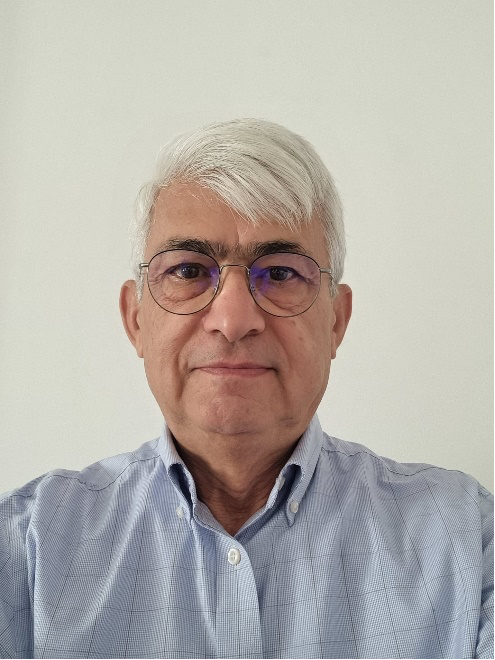
He graduated from the Department of Physics Engineering at Hacettepe University in 1975. After receiving his Ph.D. from the University of Virginia in 1981, he conducted postdoctoral research at Kansas State University. Appointed to Hacettepe University in 1982, Dr. Aydınlı worked at the Department of Physics at the University of Padova between 1988 and 1989, where he studied strain at InGaAs/GaAs interfaces using the RBS method. He became an Associate Professor in 1984 and a Professor in 1990. In the same year, he served as a Visiting Professor at the University of Toledo.
In 1991, he joined the Department of Physics at Bilkent University. Between 1997 and 1998, he conducted research on integrated optics as a Fulbright Professor at the University of California, Santa Barbara. In 2016, he moved to the Department of Electrical and Electronics Engineering at Uludağ University, where he established the Optical and Photonics Master’s program and the monthly Colloquium series. He retired in 2020 and currently provides photonics consultancy.
He has published his research in 180 articles. He was part of the team that established laboratories at Bilkent University and Ermaksan A.Ş. He has led various projects, including one supported by the EU, and has worked with numerous postdoctoral, doctoral, and graduate students. He has been involved in the organization of many workshops and founded the National Optics, Electro-Optics, and Photonics Workshop at Bilkent University in 1999. His primary research interests include semiconductor physics and technologies, quantum cascade lasers, Type-II superlattice infrared detectors, (In)GaN-based LEDs, high-power semiconductor lasers, laser-matter interactions, integrated optics, and surface plasmons.
In 2016, he joined the Department of Electrical and Electronics Engineering at Uludağ University and retired in 2019 due to the mandatory age limit. Currently, Professor Aydınlı provides consultancy and support for projects in the fields of fiber lasers and photonics. His research interests include nanocrystals, semiconductor materials and lasers, waveguide optics, plasmonic cavities, and high-power and ultrafast fiber lasers.